
Historically, spacecraft on-board data management has been divided into two separate networks based on their function:
- The platform: Requires strict timing and precision, so it has traditionally relied on technologies like MIL-STD-1553, CAN, or RS-422.
- The payload: Needs to transmit large volumes of information at high speeds, typically using the SpaceWire standard.
In an effort to reduce weight, energy consumption, and system complexity, the industry is looking to unify both types of data traffic into a single infrastructure.
In this context, Time-Sensitive Networking (TSN) is positioned as the best candidate for solving such industry needs.
Last year the European Space Agency (ESA) launched a project called SpaceTSN with the following goals:
- Analyse and characterise real-time on-board traffic, including payload
- Define representative network architecture
- Select appropriate TSN standards
- Assess COTS hardware and TSN IP cores
- Develop SpaceTSN demonstrator
- Assess activities to develop COTS TSN IP cores / software
The following companies participated as official project partners:
- Airbus Defence and Space SAS
- Thales Alenia Space France SAS
- AROBS Polska Sp. z o.o.
- ITTI Sp. z o.o.
Even though SOC-E was not part of that list, it contributed with one of the key parts of the whole SpaceTSN demonstrator: the TSN IP Core as well as TSN Switch backbone.
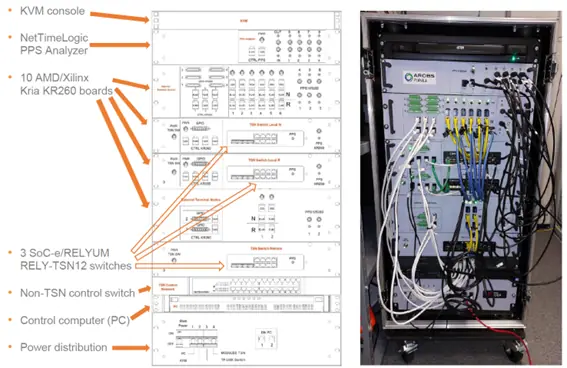
A 19-inch rack cabinet was built as part of TSN demonstrator harwarde, including up-to 10 TSN network nodes (endpoints) using SOC-E TSN IP running in AMD’s Kria KR260 Robotics Starter Kit) and TSN Ethernet switches using our RelyUm RELY-TSN12 switches (3 units).
The main use case tested was an Earh observation application example.
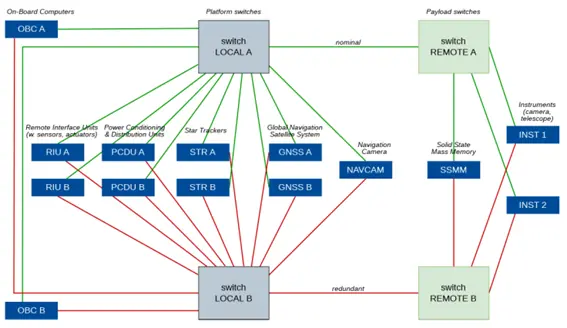
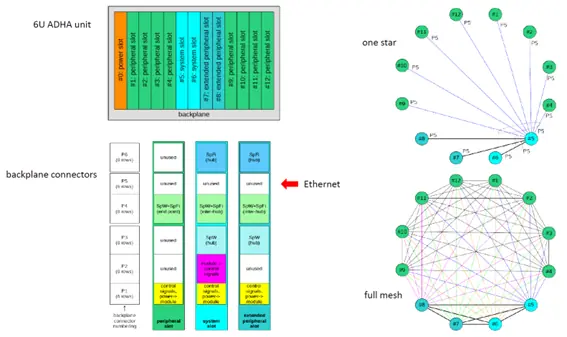
The SpaceTSN project aimed to analyse and configure current TSN protocols for space environments, specifically exploring their potential integration into the ADHA (Advanced Data Handling Architecture) framework.
As a result, some additions were proposed to the ADHA specifications, such as including Ethernet as the potential backplane communication technology (full-mesh).
More information about ADHA is available through the following link.
SpaceTSN was successfully executed and presented in 2025 EDHPC (European Data Handling & Data Processing Conference) in Elche, Spain.
It proved the usefulness of TSN in space applications. However, the determinism performance was limited by the use of a non-real time operating systems at the sender and receiver nodes.
This is a well-known problem that can be solved by either running a RTOS (such as PikeOS or VxWorks) or even bare-metal applications in the node processor. SOC-E is already performing activities that ensure compatibility with top tier RTOS providers such as SYSGO or Wind River, thanks to partnerships.
Once again, SOC-E pushes beyond what is terrestrial to deliver trusted, deterministic connectivity across space.
Take a look at our range of IP Cores: